

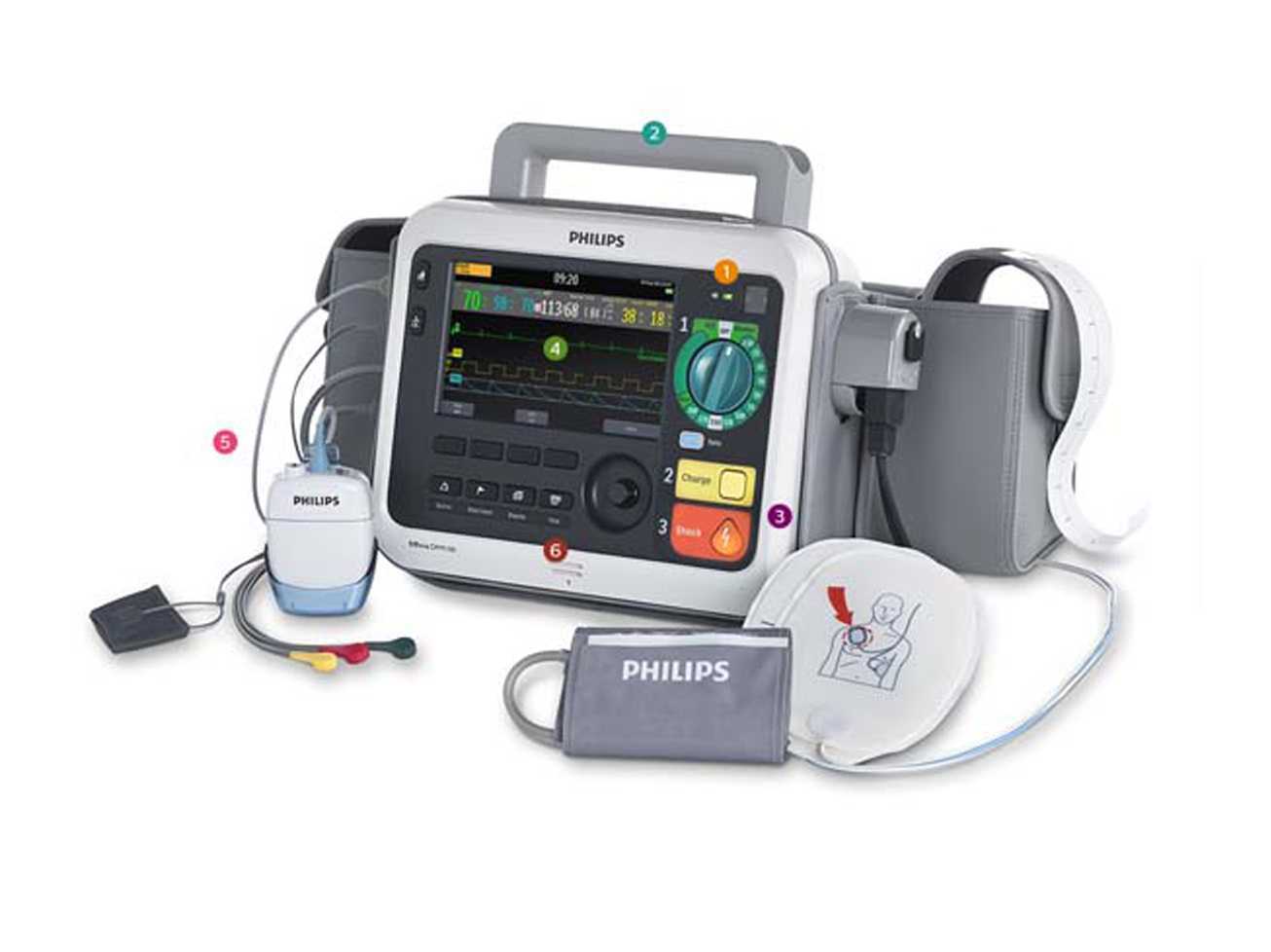
The Effi cia DFM100 is available in hospital and
pre-hospital models, and with monitoring and therapy
options. This makes it as fl exible as it is reliable.
We designed the Efficia DFM100 with your
needs in mind: to be reliable, flexible and
affordable. This is what makes the Efficia
DFM100 easy to own and easy to use. And
ultimately that means you can devote your
attention to the needs of your patient.
Transforming care, together
Philips is dedicated to creating the future of
healthcare and saving lives – but we can’t do it alone.
That’s why we collaborate with clinicians to develop
solutions that are adapted to real clinical environments.
It’s about offering you new solutions, such as
Efficia DFM100, that meet your current and future needs
Imagine the following situation.
An emergency call comes in, a patient
complains of chest pain and you spring
into action:
1. Readiness: The Effi cia DFM100 signals
its readiness with an active, fl ashing
hourglass that shows the results of
automated self-tests, and front-panel
LEDs that indicate power status – giving
you a clear indication the device is ready
for immediate use.
2. Response: The Effi cia DFM100 is small,
lightweight, and easy to carry with an
optional ruggedized, wrap-around,
carrying case – you can rapidly bring
the device to the patient’s side.
3. Defi brillation: Intuitive controls and
clear voice prompts guide you through
the steps of placing the paddles and
defi brillating the patient, with the
option of an AED mode for basic life
support providers. Advanced life support
providers can take advantage of the
full fl exibility of therapeutic options,
using the SmartSelect knob to navigate
quickly through the menus to deliver
defi brillation or pacing therapy to the
patient.
4. Monitoring: Ergonomic electrodes and
effective patient cable management make
it easy to monitor the patient’s ECG,
SpO2
, blood pressure and end-tidal CO2
,
to make informed decisions at the scene
and in the hospital, for continued care
while the patient is stabilized and during
transport.